
On 8th October 2026, a community in Nasarawa State collected clean water from a tap in its own neighbourhood for the first time in more than thirty years. SuS Pads founder Olorunfemi Boluwatife, who is also a WASH expert and project manager, joined the Hope Spring Water Charity Foundation team in Angwan Kyauta Garaku, Kokona Local Government Area, to commission a new borehole project in Nasarawa built to end a long history of water poverty. For the families who live there, this is not an infrastructure story. It is the end of a daily risk they have carried for a generation.
This account covers what the community was living with, how the Hope Spring team planned and built the project, what was said at the commissioning, and what the borehole is expected to change.
Thirty Years Without Safe Water in Angwan Kyauta Garaku
For more than three decades, the people of Angwan Kyauta Garaku have lived with water poverty. There was no safe, reliable source within the community, so families took water from whatever they could reach. Much of it came from unhygienic sources where cows and other animals defecate and urinate. Anyone who has lived near open water used by livestock knows what that means for a household that drinks, cooks, and washes with it.
The harder reality is what the search for water cost the community beyond health. The nearest alternative was in a neighbouring community, and reaching it meant crossing a road. Over the years, many children in Angwan Kyauta Garaku died in accidents on that crossing while carrying water for their families. A task that should have taken a few minutes at the edge of the village turned into a danger that parents could not remove, because the water was needed every day.
It is difficult to overstate how normal this had become. When a hazard is part of every morning for thirty years, people stop describing it as unusual. That is part of why projects like this one begin with listening rather than drilling.
From Need Assessment to Geo Survey
The Hope Spring team did not arrive with a fixed plan. They first carried out a need assessment in the community to confirm what residents were facing and how severe it was. Once it was clear that the community was suffering from water poverty, the team returned for a geo survey.
This step matters more than most people realise. A borehole is only as useful as the water it reaches. A geo survey studies the ground to identify the right place to dig and to establish how many metres the team must drill to reach a supply that can serve the whole community, not just a few households. Skipping it, or doing it poorly, is how communities end up with dry wells or sources that fail within a year. The survey gave the team the location and the depth they needed before any drilling began.
Drilling 100 Metres for a Whole Community
With the survey complete, Hope Spring moved to drilling. The team drilled 100 metres, a depth chosen to give the community a dependable supply rather than a temporary one. The joy of the community knew no bounds. People who had spent thirty years walking, queuing, and crossing a dangerous road now had water coming from the ground beside their homes.
The project did not stop at the borehole itself. The team continued with the surrounding works that make a water point usable and safe day after day:
- Masonry work to build the fetching area
- Plumbing work to connect and distribute the water
- Tiling of the fetching area, completed to keep the space clean and easy to maintain
A clean, finished fetching area is part of the health outcome. Water drawn from a protected borehole can still be contaminated if people collect it from a muddy or poorly drained surface. Building and tiling the platform keeps the point of collection hygienic.
Commissioning Day in Kokona Local Government Area
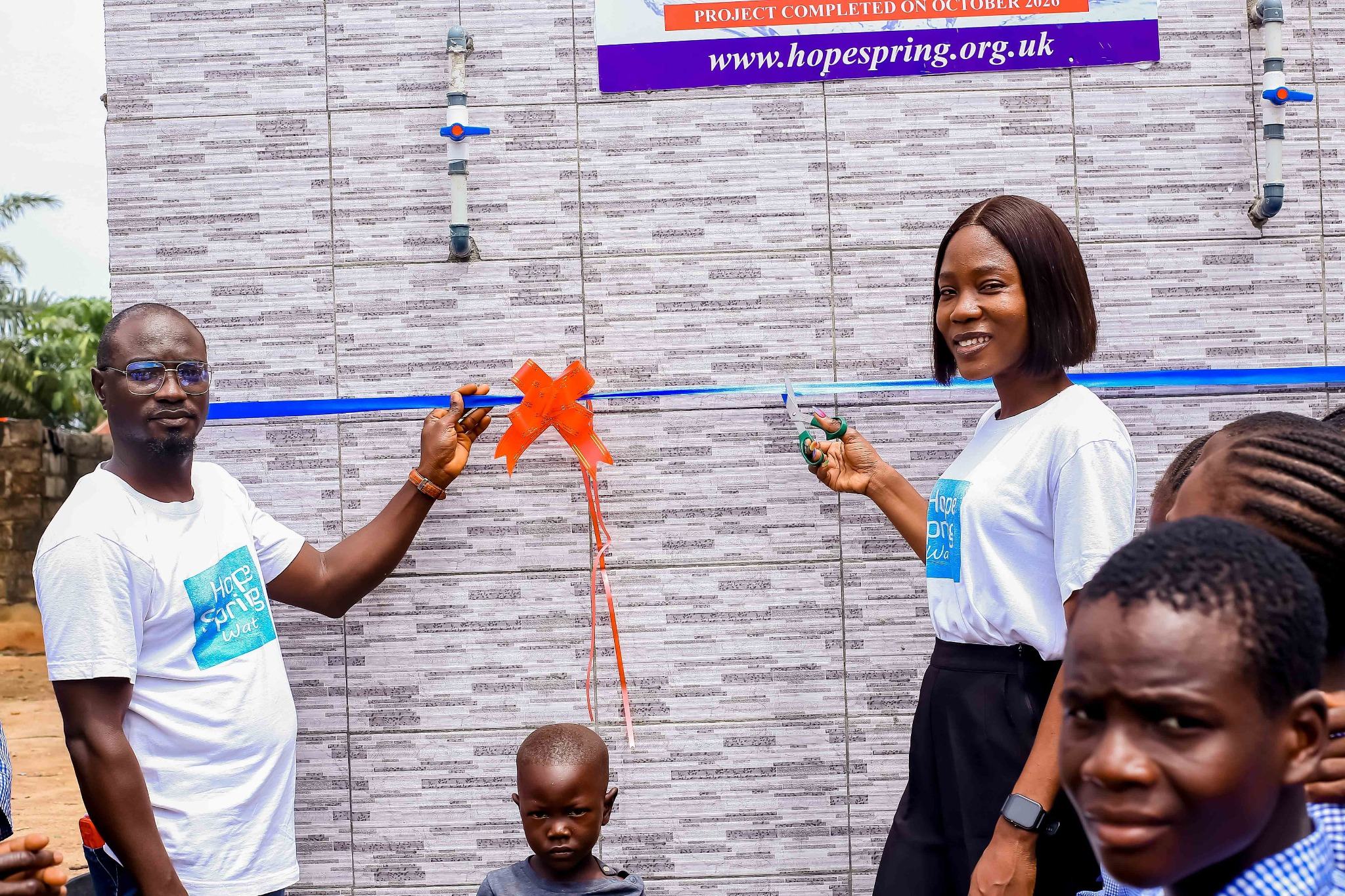
On 8th October 2026, Bolu Olorunfemi and other members of the Hope Spring team travelled to Angwan Kyauta Garaku to commission the project. Speaking as a WASH expert and project manager, she said, “On behalf of Hope Springs Water, I commission this project.”
She then explained what the project is expected to do for the community. It will increase the productivity of the women in Angwan Kyauta Garaku, who carry most of the burden of fetching water. It will reduce casualties among children who were being hurt while crossing the road to reach water elsewhere. It will stop children from missing school or arriving late because of water scarcity. And it will reduce waterborne illnesses in the community.
She also gave the community a responsibility. She urged residents to maintain the water well, and she told them that the Hope Spring Water team will return regularly to check the water from time to time.
What Clean Water Changes for the Community
More Time and Energy for Women
In many Nigerian communities, collecting water falls mostly to women and girls. Hours spent walking and waiting are hours that cannot go into farming, trading, caring for children, or resting. A water point inside the community returns that time. For a household, that can mean the difference between one income-generating activity and two.
Safer Roads for Children
The most painful part of this story is also the most direct one to fix. When water is available inside Angwan Kyauta Garaku, children no longer need to cross that road to collect it. The risk that cost lives for years is removed at the source, not simply managed.
Children Back in School on Time
When a child has to fetch water before class, school becomes the thing that gets squeezed. Some arrive late. Others do not arrive at all. With water close to home, that morning errand shrinks, and attendance has a chance to stabilise.
Fewer Waterborne Illnesses
Drinking water contaminated by animal waste is a well-known route for diarrhoeal disease and other infections. Moving the community onto a protected borehole cuts that exposure. Regular checks on the water by the Hope Spring team add another layer of protection.
Why This Matters Beyond One Community
Angwan Kyauta Garaku is not an isolated case. According to UNICEF Nigeria, more than 86 per cent of Nigerians lack access to a safely managed drinking water source, and contaminated drinking water contributes to diarrhoeal diseases that kill more than 70,000 children under five in the country each year. Globally, the WHO and UNICEF report that one in four people, about 2.1 billion, still lack safely managed drinking water, including 106 million who drink directly from untreated surface sources.
Those numbers are why WASH work matters. Water, sanitation, and hygiene are tied to child survival, school attendance, women’s economic activity, and menstrual health. A girl who has clean water at home is better able to manage her period with dignity and stay in school. This is the connection between the borehole in Kokona and the menstrual health training SuS Pads delivers in communities: both are about removing the barriers that keep women and girls from full participation in daily life.
A Sustainable Approach to Water Poverty
A borehole is not a one-day gift. Its value depends on what happens after the ribbon is cut. That is why the commissioning included both a handover and a commitment. The community has been asked to look after the well, and the Hope Spring team has promised to keep returning to check the water. Local ownership combined with outside follow-up is what tends to keep water points working for years rather than months.
This is what makes the Hope Spring Water Charity Foundation’s approach a sustainable way of alleviating water poverty: assess the need, survey the ground, build the full water point, and stay connected after handover.
Frequently Asked Questions
Where was the borehole project commissioned?
The project was commissioned in Angwan Kyauta Garaku, Kokona Local Government Area, Nasarawa State, on 8th September 2026.
Who commissioned the borehole?
Olorunfemi Boluwatife, founder of SuS Pads and a WASH expert and project manager, commissioned the project on behalf of the Hope Spring Water Charity Foundation.
How deep is the borehole?
The team drilled 100 metres, based on the findings of a geo survey carried out before drilling began.
Why was this community chosen?
A need assessment by the Hope Spring team found that the community had lived with water poverty for over 30 years, relying on unhygienic water sources and facing a dangerous road crossing to reach water in a neighbouring community.
How will the borehole be kept in good condition?
The community has been asked to maintain the water well, and the Hope Spring Water team will return regularly to check the water.
Be Part of Changing Lives
Clean water should not be a luxury, and no child should lose their life crossing a road to get it. If this project moved you, you can support the work of the Hope Spring Water Charity Foundation and help bring water to more marginalised communities. Reach out to Hope Spring through www.hopespring.org.uk and be part of changing lives.
If your school, organisation, or community would also benefit from WASH or menstrual hygiene training, contact SuS Pads to start that conversation.
0 Comments